PVA TePla
300
The Tepla 300 is a high-frequency plasma etcher used for photoresist stripping and surface cleaning. The Tepla 300 operates at 2.45 GHz with power from 200 to 1000 W. The Tepla 300 processes wafers from 75 mm to 100 mm and is not micro-electronic compatible.[1]
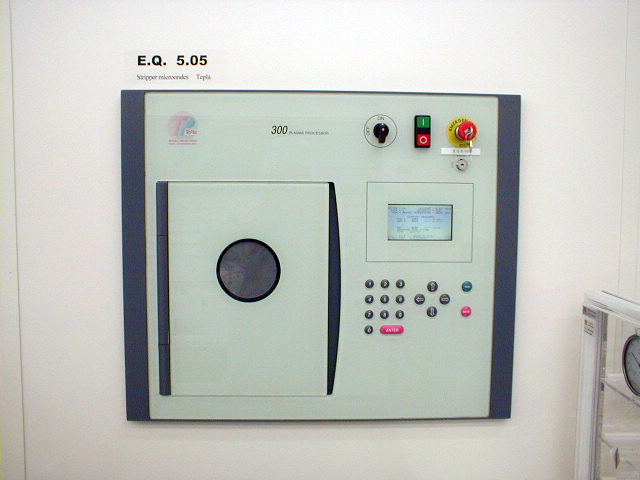
How it works
The PVA TePla 300 operates at a working pressure of 0.6 to 1.5 mbar. Plasma excitation is achieved by a 1000 Watt microwave power supply operating at 2.45 GHz. The system can run recipes with up to 100 programs each containing up to 5 steps, allowing sequential variations in gas flow, power, and process time. A Faraday cage is available as an accessory to fit inside the chamber; when installed, it prevents direct microwave coupling to the wafers, reducing wafer temperature and providing a gentler process by allowing only diffused oxygen radicals to reach the samples.[1][2][3]
Applications
In addition to organic stripping, the tool can be used to etch silicon and silicon nitride when appropriate gas mixtures are employed. The system supports multiple single-step and multi-step recipes, with programmed parameters for gas flow, power, and end-point detection. Standard process libraries include programs for photoresist stripping at various durations and for surface activation at reduced power levels.[1][2][3]
- Photo Resist (PR) stripping
- Wafers surface cleaning before subsequent processes
- Enhancement of hydrophilic behavior of plastics surfaces
Why won't it start?
Documented failure modes, common issues, and field considerations.
- Materials that deteriorate easily upon exposure to oxygen, including Ag, Cu, Cr, and Fe, should not be processed in this machine.
What do the numbers mean?
Vacuum & pumping3
Wafer handling15
- Applications
- Photoresist stripping; wafer surface cleaning; hydrophilic surface activation of plastics surfaces[1]
Gas & chemistry8
Dimensions & facilities3
Configuration & options13
- Restricted Materials
- Materials that deteriorate in oxygen (Ag, Cu, Cr, Fe, etc.) should not be processed; no Cr or other metals in chamber[1]
Vintage & configurations
Documented models & variants
What replaced it?
Related models
- siblingPVA TePla GigaBatch— Alternative for micro-electronic compatibilitysource[1]
What does it need to run?
Site utility requirements, footprint, and infrastructure needed to install and operate this tool. Sourced from public records.
- GasO2 (max. flow 500 ml/min)[1]
- ChamberQuartz primary vacuum chamber, Dint. 245 mm x Prof. 380 mm[1]
- CategoryPlasma etcher (resist strip / surface activation)[1]
- GasO2 (max flow 500 ml/min), optionally CF4[1]
- Positive resist etch rate350 nm/min[1]
- Process GasesO2, Ar, N2, CF4[2]
- Process Pressure0.6 to 1.5 mbar[3]
- Process gasesO2, CF4, Ar, N2[2]
- Gas 1O2 (max. flow 500 ml/min)[1]
- Process gasO2 (max flow 500 ml/min)[1]
- Chamber dimensionsQuartz primary vacuum chamber, Dint. 245 mm x Prof. 380 mm[1]
Where are the manuals?
Generated from public-source data on file. Enter your email to access — nothing is published; details are routed privately.
Not publicly documented
Field notes
No research found yet — worked with this tool? Share what you know.
Frequently asked questions
What gases does the PVA TePla 300 support?
The system supports oxygen (O2) as the primary process gas, with optional CF4, argon (Ar), and nitrogen (N2).[2][3]
What is the operating frequency and power range of the Tepla 300?
The microwave frequency is 2.45 GHz, and the power output can be set from 0 to 1000 W, typically between 200 W and 1000 W.[1][2][3]
What wafer sizes can be processed?
The quartz carrier holds wafers from 75 mm to 100 mm diameter, up to 25 wafers per batch.[1]
Not publicly documented
The following facts about the 300 are absent from this record as of this revision. First-hand knowledge or a citation closes a gap; every submission is reviewed before publication.
No publicly documented production dates or lifecycle milestones (introduction, end of production, EOL) for the 300 are on record.
Answerable by: OEM historical records or a trade-press announcement
The control-system platform and OS era of the 300 are not on record.
Answerable by: an engineer who operated it or OEM installation records
The process node or technology generation of the 300 is not on record.
Answerable by: an OEM datasheet or a fab qualification report
No publicly documented compatible parts, consumables, or accessories for the 300 are on record.
Answerable by: an OEM parts catalog or a service engineer
No publicly hosted manuals, SOPs, or datasheets for the 300 are on record.
Answerable by: university cleanroom staff or an OEM application specialist
Sources & citations
Sources (4)Every fact above is drawn from these public sources
- [1]epfl.ch — epfl.chepfl.ch
- [2]nist.gov — nist.govnist.gov
- [3]polifab.polimi.it — polifab.polimi.itpolifab.polimi.it
- [4]Dry Etching — tudelft.nltudelft.nl
Last updated Oct 8, 2026.
Compare with similar tools
View all →
Headway 1 EC 101 R 485 is a photoresist spinner with stated vacuum and electrical requirements.

The CEE 100 is a spin coater with a listed power specification of 115 volts and 800 watts.

The EV Group 120 Automated Coater Processing System is an automated coater for 6-inch and 8-inch wafers, built in 2015 and requiring 50/60 Hz, 3-phase, 4-wire plus ground power.
